
DRDO’s Missile Test on the Anniversary of Operation Sindoor
The next-generation Intercontinental Ballistic Missile (ICBM) was effectively tested by India’s Defence Research and Development Organization (DRDO) on May 8, 2026. In May 2025, India carried out Operation Sindoor, a historic three-service military operation in response to the terrible terror attack in Pahalgam, Jammu and Kashmir, on April 22, 2025. This was an outstanding achievement for DRDO, and it took place on the first anniversary of Operation Sindoor.
Why Experts Suspected an Agni-6 ICBM Test
Indian officials told the air force in a NOTAM that they were going to test a long-range missile in the Bay of Bengal from May 6th to May 9th, 2026. In general, such sorts of notices are given out before missile launches or big military exercises. A lot of experts believed that India might be gearing up to test the Agni-6 ICBM missile since this was taking place around the same time as the first anniversary of Operation Sindoor.
Also, DRDO chief Samir V. Kamat recently said that the organization is prepared to test a missile with a range of more than 10,000 km and could do so at any time, as long as the government gets the go-ahead. As a consequence, a lot of people speculated that India was getting ready to launch an Agni-6.
DRDO eventually tested a more advanced Agni missile with an MIRV (Multiple Independently Targetable Re-entry Vehicle) system in the air from Dr. APJ Abdul Kalam Island on May 8, 2026. The test went well. Tracking was done by systems on the ground and on ships in the Indian Ocean. The missile had various payloads that were intended for different targets. Flight data verified that all mission goals were met, demonstrating once again that India can hit multiple vital targets with a single missile.
Agni-5 MIRV Test Marks a Major Strategic Achievement
Earlier in May 2024, DRDO tested the Agni-5 MIRV successfully as part of Mission Divyastra. This was a significant step ahead for India’s strategic defense and showed that it could launch multiple warheads that could be aimed at multiple locations from a single missile. This was the second test of its kind for MIRV. With two tests that went well, it looks like DRDO could be putting this system into use soon. It’s still unclear if they intend to carry out a few more tests like these before giving the device to the Strategic Forces to use.
What is MIRV Technology and Why It Matters
Given MIRV technology, a single ballistic missile can carry and launch multiple weapons, each of which is capable of hitting a different target on its own. MIRV technology was created during the Cold War and was first used by the US in the LGM-30 Minuteman III. It totally transformed strategic missile warfare by rendering it easier to launch attacks. Today, countries like the US, UK, France, China, and Russia can use MIRVs.
Pakistan’s Ababeel Missile and the MIRV Debate
Pak states that the Ababeel, its medium-range ballistic missile, has MIRV technology built into it. Reports say the missile has a range of about 2,200 km and is assumed to be able to carry more than one warhead. They might have tried a system that could handle MIRV in 2017. But such assertions continue to be looked into because there isn’t a lot of independent verification, and some analysts have questioned how successful and mature Pakistan’s MIRV testing program is.
India’s Nuclear Journey from Pokhran to Agni-5
With the successful test of the Agni-5 by the DRDO on April 19, 2012, India advanced into the arena of long-range strategic missiles. It can carry nuclear weapons and has a range of more than 5,000 km. India revealed it could make nuclear bombs with Pokhran-I (Smiling Buddha) in 1974.
It enhanced its spot in the world even more in 1998 (Pokhran-II), when it conducted five nuclear tests. On the contrary, owning nuclear weapons is only the first step toward becoming a nuclear-weapon state. To become a nuclear-weapon state, a country must be able to make warheads smaller, make delivery systems that are capable of escaping assaults, and make sure it has an effective second-strike capability.
The Importance of the Nuclear Triad in Modern Warfare
Getting nuclear technology viable as a weapon is a highly complex engineering process that involves developing warheads, enhancing yields, processing fissile materials, adding safety features, and integrating delivery systems. Modern nuclear warheads are small and light to ensure that they can be used with an array of delivery options. The nuclear triad is made up of these three bases.
Three important parts make up a viable nuclear triad: strategic bombers for delivery from the air, long-range or CBMs for deterrence on land, and submarine-launched ballistic missiles (SLBMs) for a second strike that can be survived.
For this triad, MIRV technology is part of the land-based missile part. By having a single missile carry multiple distinct targetable warheads, MIRVs greatly enhance the adaptability of strikes, the ability to penetrate, and the value of deterrence. India has joined a small group of countries with advanced nuclear delivery technologies by adding MIRV capability to the Agni-5 program. This shows that India is moving toward more advanced and survivable strategic weapons.
Incorporating MIRV technology into the Agni-5 is a big step toward the future in India’s Agni missile program, which has been going on for decades. India’s government has been making moves in the weapons field for a long time. The Government of India approved the establishment of the Integrated Guided Missile Development Programme (IGMDP) on 26 July 1983.
IGMDP is the company that made the Agni-1 and also made the Prithvi, Akash, Nag, and Trishul missile systems. DRDO first thought of Agni as a technology demonstrator for re-entry vehicle proof. The first Agni used a solid-fuel first stage from the SLV-3 space launch vehicle and a changed upper stage. India tried the Agni demonstrator successfully in 1989. In 1992 and 1994, they did better tests. DRDO turned the system into the single-stage Agni-1 ballistic missile after finishing studies on re-entry. The official start of work on this system was in 1999, and it was finished and ready for use in 2003.
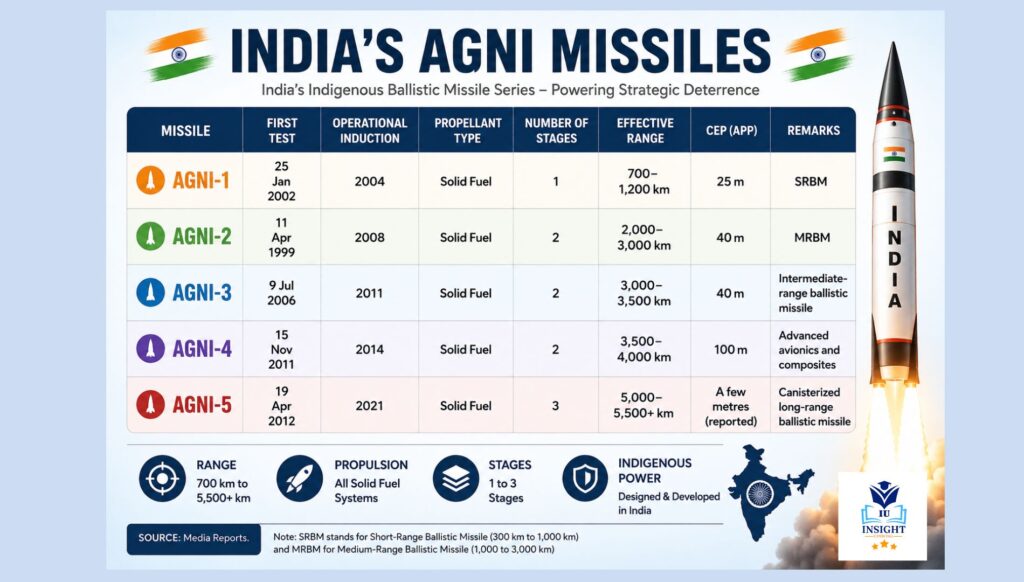
At the moment, DRDO is trying to make India’s nuclear strike capabilities much wider than just its immediate surroundings. The successful addition of MIRV capabilities to the Agni-5 is not the end of India’s missile development program, but it is a major step forward in its continued growth. Reports say that Agni-6 ICBM is being worked on right now and may soon be ready for tests. The next-generation project should make range, movement, and payload options even better. India has made a lot of progress in the advanced seeker and tracking technologies needed for ICBMs, as shown by the many successful Agni-5 tests.
Agni-6 ICBM Could Transform India’s Strategic Reach
India’s next-generation Agni-6 system should be lighter, more flexible, and easy to set up quickly. It could have a range of more than 10,000 km, though most estimates put it at between 8,000 and 12,000 km. The rocket should also have both MIRV and Manoeuvrable Re-entry Vehicle (MaRV) capabilities. This will make it much more flexible in how it strikes, more likely to survive, and better able to get past advanced missile defense systems.
MaRV Technology and India’s Future Missile Capabilities
It seems that DRDO aims to ensure that the Indian missile system can get past the best missile defense systems in the world, like the S-500 in Russia, THAAD in the US, and HQ-19 in China. Ten to twelve weapons should be on the Agni-6 ICBM. To defeat the S-500, THAAD, and other similar systems, it will be important to use MaRVs, improved decoys that trick radars, and coatings that absorb radar waves. A MaRV is a type of payload for a ballistic missile that is meant to change its flight path when it hits the atmosphere again. Because a MaRV can change its path, it can get around enemy missile defense systems. India has not yet tried out the MaRV device.
The Evolution of India’s Agni Missile Program
It is important to note that there aren’t any major, official details about an Agni-6 ICBM program that are known to the public. There are, however, times when it seems like a system like this might be being worked on. But tests of such a weapon have not yet taken place. India may not be testing this kind of system at this time because of several regional and strategic reasons.
As part of its nuclear posture, India sticks to a credible minimum deterrence policy. In such a system, the key objective is to make sure that people can survive and have a reliable second-strike potential. Since the Agni-5 already has a knack for reaching distances between continents, having or experimenting with a longer-range system like the Agni-6 ICBM would not significantly change the current balance of deterrence. Because of this, testing systems like Agni-6 ICBM are not needed right away.
Agni-5 MIRV Sends a Strong Geopolitical Message
Testing plenty of missiles has a profound impact on sending important geopolitical messages. India’s test of a new ICBM with a range of 10,000 km could have been seen as a threat by countries other than China and Pakistan. As matters stand, there are already two ongoing nuclear conflicts in the world. This test could have made things worse and led to other countries, mostly China and Pakistan, developing or testing missiles in response. At this moment, the successful test of the Agni-5 with MIRV capability conveys a clear signal about India’s nuclear deterrence strategy.
This article is based on research and analysis inspired by the article titled “India Tests Agni-5 with MIRV Capability” published by the Manohar Parrikar Institute for Defence Studies and Analyses (IDSA) on May 11, 2026, written by Ajey Lele. Full credit for the original strategic insights and foundational analysis goes to the author and IDSA.
Table of Contents
